Middle School Educator Resources
— Grades 6–8
Middle School Educator Resources
Support Independence Without Leaving Students to Figure It Out Alone
Middle school is a transition point.
Students are becoming more independent, more aware of themselves and others, and more capable of handling complex ideas — but they are also still learning how to manage time, organize responsibilities, communicate effectively, recover from mistakes, and ask for help when they need it.
This space is designed to support educators working with Grades 6–8 with practical resources, adaptable activities, subject-based materials, and tools that help students take greater ownership of their learning.
The goal is not to add more work. It is to give you useful places to turn when students need structure, challenge, support, or another way into the material.
Explore by Subject
📚 Reading & Literacy
Support deeper comprehension, vocabulary, literary analysis, structured writing, research, argument, source evaluation, discussion, and the development of a stronger personal voice.
🔢 Math
Support ratios, proportions, percentages, integers, equations, geometry, statistics, probability, graphing, introductory algebra, and increasingly independent problem solving.
🌿 Science & Nature
Encourage investigation through biology, ecosystems, cells, genetics, Earth science, chemistry foundations, physics concepts, environmental science, data, and scientific reasoning.
🎨 Art & Creativity
Support creative development through visual art, photography, design, music, theater, creative writing, digital media, cultural traditions, critique, and personal expression.
🌍 History, Culture & Geography
Help students examine civilizations, migration, trade, government, conflict, culture, geography, primary sources, competing perspectives, and the connections between past and present.
🏠 Life Skills
Help students strengthen organization, time management, communication, money basics, decision making, digital citizenship, self-advocacy, responsibility, and practical independence.
Learning Beyond the Lesson
Give Students Room to Think
Middle school students are ready to move beyond simply completing tasks and begin making connections, questioning information, testing ideas, and developing opinions of their own.
Activities that invite investigation, discussion, creativity, and real-world application can help students see learning as something they participate in — not something that only happens to them.
🧩 Challenges & Brain Teasers
Use logic problems, puzzles, strategy games, mathematical challenges, word problems, and collaborative tasks to strengthen reasoning, persistence, and flexible thinking.
🧪 Investigate & Experiment
Give students opportunities to form questions, test ideas, collect evidence, organize data, evaluate results, and explain what they discovered.
🔎 Research & Discover
Encourage students to investigate questions, compare sources, evaluate information, explore current and historical topics, and follow interests beyond the textbook.
✍️ Write, Design & Create
Use essays, stories, journalism, visual design, presentations, comics, poetry, multimedia projects, and creative challenges to let students communicate ideas in different ways.
📖 Story Corner
Reading Can Become Personal Here
Middle school readers are beginning to discover what they like, what they question, what they relate to, and what kinds of stories stay with them.
Use Story Corner to explore books and reading experiences that can support independent reading, classroom discussion, writing, research, creative projects, and connections across different subjects.
Not every book needs to become an assignment. Sometimes the most important thing a student can discover is that reading can belong to them.
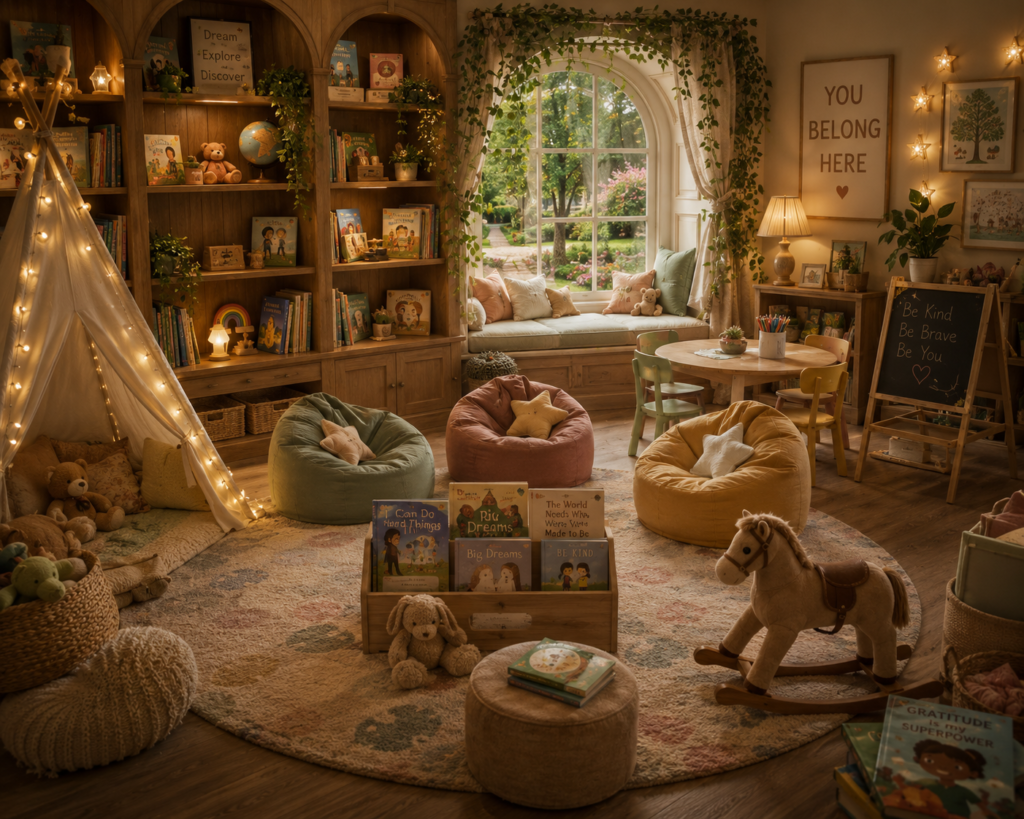
Step into the SNO Children’s Library
Growing as a Learner
Independence Is a Skill, Not an Expectation
Middle school students are learning how to manage competing responsibilities, navigate relationships, organize schoolwork, make decisions, communicate needs, and take greater responsibility for their learning.
These skills do not appear automatically with age. They develop through practice, guidance, reflection, and opportunities to try again.
🌱 Confidence
Help students recognize progress, take appropriate academic risks, recover from mistakes, and build trust in their ability to learn something that does not come easily at first.
🤝 Cooperation
Support respectful disagreement, shared responsibility, listening, teamwork, group decision making, and the ability to contribute meaningfully without needing to control every part of a project.
🗣️ Communication
Encourage students to ask clear questions, explain their reasoning, participate in discussion, express needs respectfully, write appropriately for different situations, and listen to perspectives other than their own.
🧠 Critical Thinking
Create opportunities for students to compare claims, examine evidence, identify assumptions, recognize bias, question sources, and consider more than one possible explanation.
🎯 Goals & Progress
Help students set realistic goals, break larger tasks into smaller steps, monitor their own progress, reflect on what is working, and adjust when a strategy is not helping.
🧺 Independence & Organization
Support students as they learn to manage assignments, deadlines, materials, schedules, projects, digital tools, and personal responsibilities while still knowing when to ask for support.
Connect With Families
Support Changes as Students Grow
Middle school families often face a difficult balance: students need more independence, but they are not yet ready to manage every responsibility alone.
Families can support learning by helping students build routines, organize schedules, discuss goals, manage responsibilities, read together when it still feels natural, explore interests, and remain available without taking over every task.
Use Dendera’s Family Resources when you want to share practical tools and ideas that help families support growing independence without turning home into a second classroom.